The Last House on the Line: How Cul-de-Sacs Became America's Internet Backwaters
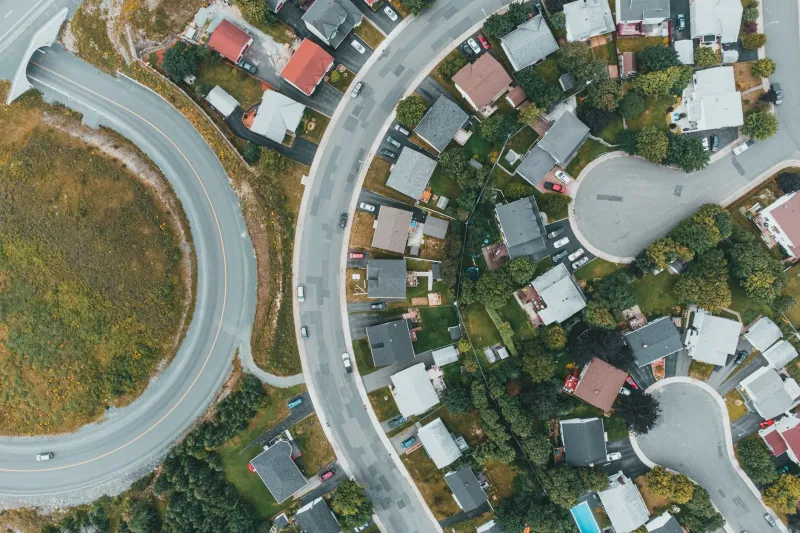
Ask a real estate agent what makes a cul-de-sac home desirable and you'll get a familiar script: less traffic, bigger lots, kids playing basketball in the street. Ask a network engineer the same question and you'll get a wince.
That's because the dead-end street — the crown jewel of suburban planning — is also the worst place in the neighborhood to be at the end of a wire. The house with the cul-de-sac premium and the private backyard is frequently the same house sitting at the tail end of a miles-long cable cascade, where every splitter, splice, and overloaded node between it and the provider's hub takes a small bite out of performance.
The Longest Pipe Problem
Most American neighborhoods were wired on a simple principle: run the cable past as many homes as possible with as little material as possible. In coax and older DSL deployments, that means a trunk line snakes through the subdivision, with individual drops branching off like tree limbs. The homes near the trunk's origin get a clean signal. The homes at the end of the branch — disproportionately the ones on curved streets and dead-ends — inherit everything the signal picked up (and lost) along the way.
Engineers call this attenuation, but the everyday version is simpler: distance and devices degrade your connection. In cable internet, upstream congestion at the neighborhood node matters even more. If that node serves 500 homes and the cul-de-sac crowd is the farthest from it, they feel the evening crunch first and hardest.
Fiber changes the math, but not entirely. A passive optical network still splits its capacity across a neighborhood, and while distance matters far less over glass, the placement of the splitter — often a cabinet near the subdivision entrance — means the last homes lit are frequently the last homes activated when a provider finally builds out. In plenty of towns, fiber arrived on Main Street years before it curled around to the back of the development.
When the Map Was Drawn for Cars, Not Packets
There's no villain here, just legacy design. Postwar subdivision layouts optimized for curb appeal and traffic flow, not signal integrity. Curved streets look great from a drone shot and terrible from a network diagram. Every extra hundred feet of copper is a small tax; every additional home sharing a node is another.
The result is a strange inversion of real estate logic. The lots that command the highest prices — quiet, remote, at the end of the street — often have the worst infrastructure position. Meanwhile, the house backing onto the busy entrance road may be the first one in line for a fiber drop.
"I've had buyers ask about internet before they ask about the roof," one suburban agent told us, only half-joking. In an era of remote work, a house that can't sustain a video call is a house with a problem, and buyers are increasingly savvy enough to check address-level availability maps before they check the school district.
Is 'Internet Desirability' Priced In?
Hard data on this is still emerging, but the direction is clear. Multiple studies of broadband expansion have found measurable home value effects when high-speed service arrives — and by extension, a penalty where it doesn't. Appraisers don't yet have a checkbox for "node congestion," but agents in fiber-vs-DSL markets will tell you which listings get more showings.
The policy question is thornier. If infrastructure quality tracks street layout, then the market is quietly sorting Americans by address — not by income or need, but by where a cable happened to terminate in 1978. Rural advocates have made this argument for years; the cul-de-sac shows the same dynamic operates inside wealthy suburbs too.
Fixes exist. Providers can rebalance nodes, add line extenders, or — the real answer — finish fiber builds to the last few homes on the line. Some state broadband grants now specifically target these leftover pockets, the addresses that fall just outside the census blocks that qualify as underserved.
Check Before You Close
If you're house hunting, treat the internet like a utility you're actually going to depend on. Look up the address on provider availability maps — not the neighborhood's. Ask which technology serves the street, not just the zip code. And if the lot is a stunner at the end of a long, winding road, ask the neighbors two doors down what their speeds look like on a Tuesday at 8 p.m.
That dream home at the end of the cul-de-sac might be everything the brochure promises. Just make sure the last house on the line isn't yours.